New USDA “Final Rule” Requirements: A Food First Approach to Scratch Cooking in Schools
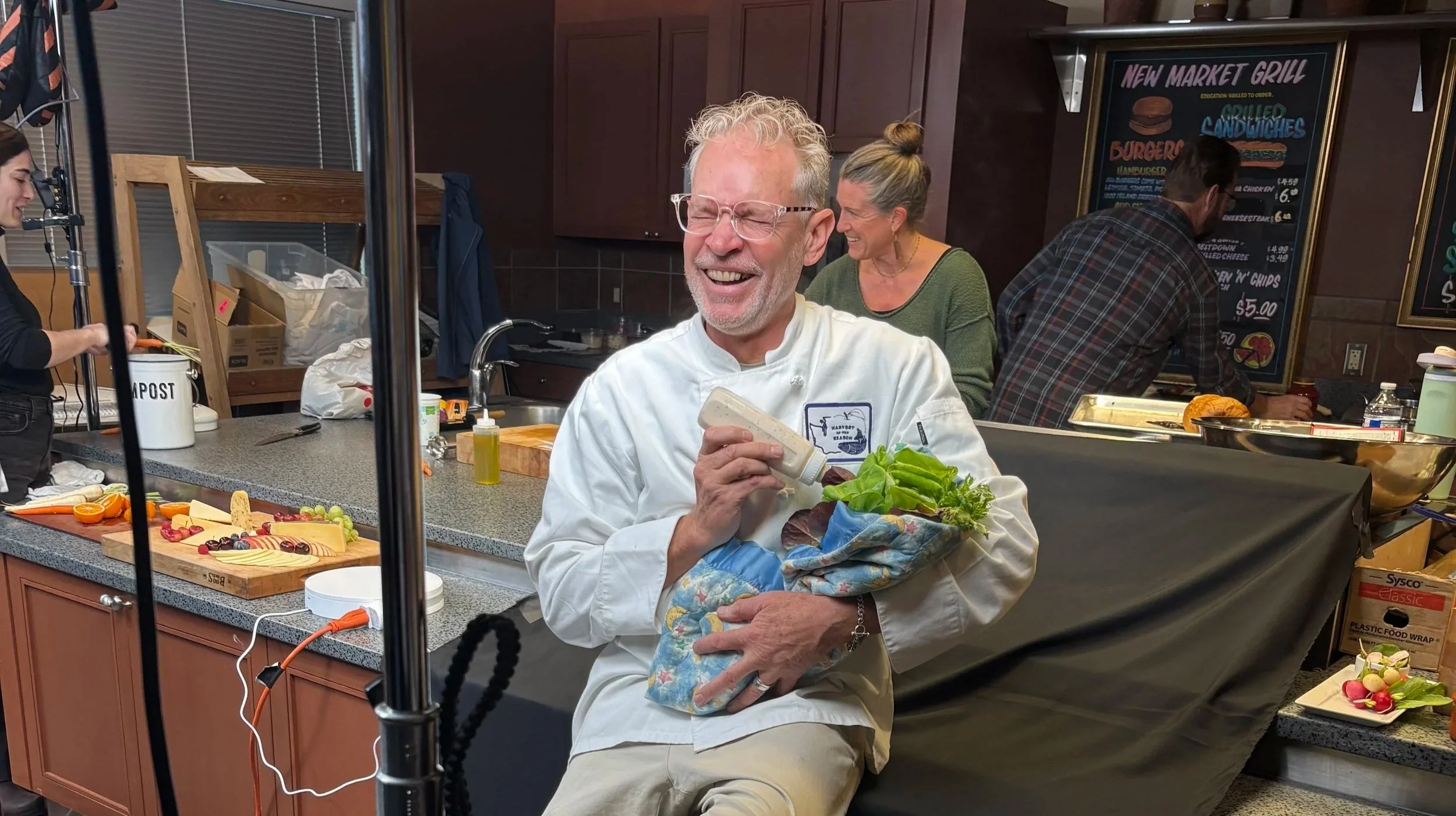
During one of our Harvest of the Season video shoots, I somehow ended up cradling a bundle of fresh greens like a newborn baby.
We were having fun on set. Chef Mataio and I tend to do that. At the time, it was just a goofy photograph. Looking back at it now, though, I think this picture visually sums up what I think is the top priority for any business that feeds people.
And that is to put the Food First.
Handle it with care, nurture it well while its under your control, then make it into something people really want to eat.
Way back in May of 2025, I received an email from the Child Nutrition team at Washington State’s OSPI. They were working on a USDA Team Nutrition grant and wanted help with a couple of projects. One would involve developing scratch recipes to support the new USDA Final Rule meal-pattern changes. The other project would involve producing culinary videos. My immediate reaction was something along the lines of: Two projects?! Right-on!!
I may have underestimated the enormity of the task at the time, but here we are!
Fast-forward more than a year, countless recipe tests, many school kitchen visits, student tastings, video shoots, script revisions, ingredient wrangling, and more than a few dirty dishes later…
They’re done. And I’m really proud of what came out of them.
Project #1: Harvest of the Season and The New USDA Rules
For the video project, my friend Chef Mataio Gillis and I partnered with OSPI to create a series of videos featuring 24 foods grown and raised right here in Washington State and five videos explaining and depicting ways to meet the new Final Rule meal pattern changes.
The goal for both projects was:
Provide approachable ideas and ways to apply the new rules, and to serve beautiful, Washington produced ingredients easily in school meals programs.
That meant depicting real culinary techniques that can actually be used in real school kitchens. Roasting. Seasoning and flavoring. Sautéing. Preparing tender greens. Processing winter squash. Working with mushrooms, potatoes, brassicas, herbs, berries, pears, and apples. We wanted to “pull back the curtain” so to speak on how chefs would approach these ingredients in K-12 friendly way and also how to apply the new rules while doing so.
If you learn what “Roasting” is, a little bit about flavor development, and one simple approach to apply roasting to vegetables you haven’t just learned how to make roasted carrots, you’ve learned how to roast nearly any vegetable on the planet! You’ve learned a set of skills that will completely change how you approach the next case of vegetables that arrives at the loading dock.
Skills make great ingredients shine. And skills build confidence. That matters a lot as Farm to School programs continue bringing more whole and locally grown foods into school kitchens. You can explore the completed series of videos here: Harvest of the Season video series
There are tons of other valuable F2S resources available at this link also.
Project #2: Make Something Kids Will Eat
The second project attacked the challenge of feeding kids well from another perspective. OSPI asked me to develop scratch recipes supporting several of the new USDA meal-pattern requirements, including low-sodium lunch entrées featuring beans, peas and lentils, along with lower-sugar, lower-sodium breakfast recipes featuring vegetables and meat/meat alternates. I started by submitting something like sixteen ideas, then we narrowed them down to five:
Hearty Indian-Style Lentil Soup (also known as Dal)
No-Bake Breakfast Protein Orb’z (with no added sugar)
Avocado Toast with Tofu Scramble
Chilaquiles Verdes using a combi-oven method
Southern-Style Sausage and Pepper Jack “Meal-in-a-Muffin”
Then came the glamorous part of recipe development:
Test. Test. Test. Change something. Run to the grocery store. Test again. Repeat.
But this project had another wrinkle. These recipes had to work in school kitchens. And ultimately, they had to face the toughest focus group in foodservice: The actual kids.
We quantity-tested all the recipes in real school kitchens for 50 and 100 servings, and conducted student taste tests, working toward an acceptability rating of at least 85 percent. A recipe can meet every nutritional target. It can credit beautifully. The sodium can be just right. The added sugar can be minimized. The documentation can be flawless. But somebody still has to want to eat it.
As soon as OSPI publishes the finished recipes, I promise to share links to all five!
And That’s Where These Two Projects Meet
On paper, these were two very different projects. One was about Washington-grown foods and culinary education. The other was about recipe development, new USDA requirements, quantity testing and real student acceptability. But after working on both of them, I see them as two parts of the same idea.
How to Put the Food First:
Start with excellent ingredients and get to know them really well. Understand what they need for their best life as they go from the receiving dock to the belly.
Enrich the people assigned with preparing those “little babies” the necessary culinary skills they need to be successful.
Establish the quality systems that support and sustain this important work of feeding kids well.
Taste the food.
Listen to the students.
Make adjustments.
Meet more often to create, communicate, and collaborate.
Have fun! Your enthusiasm is contagious.
Doing these things will give your beautiful food ingredients their best chance of deliciously making it those last few feet from the kitchen, to the serving line, to the tray, and finally to the student.
Local purchasing matters, nutrition standards are important, and yes the recipes matter too! But somewhere in the middle of all of that is a cook standing in front of a case of food deciding what happens next. That is why building culinary understanding in your team matters so much.
A well-trained, confident cook has more capacity, and sees the possibilities in that case of veggies, instead of the problems. I think that is why the ridiculous (and cute) picture of me holding a bundle of greens like a newborn baby works. There’s some truth hiding in that joke.
Good food deserves to be handled with care, and equally important, it deserves good cooking.
Twenty-four videos. Five new recipes. Hundreds of little decisions and adjustments along the way.
Two big, hairy projects.
Done.
Whew! You should go check them out!