What Else Can This Become? The Planned-Overs Approach to Menu Planning in School Kitchens
In every kitchen, leftovers happen. Sometimes we cook a little too much. Sometimes fewer students come through the line than expected. Sometimes a menu item does not move the way we thought it would.
This is normal in food service.
But what would happen if we actually planned for them and even relied on them as ingredients in another menu item coming later in the week? What if we stopped thinking of those foods as "leftovers" and started thinking of them as ingredients with a future?
That is the idea behind what we call The Planned-Overs Approach to Menu Design.
Planned-Overs is a simple way of thinking about menus, recipes, and food production. Instead of planning each menu item in isolation, we look at how one food can intentionally be used in more than one way throughout the week.
Examples of Planned-Overs
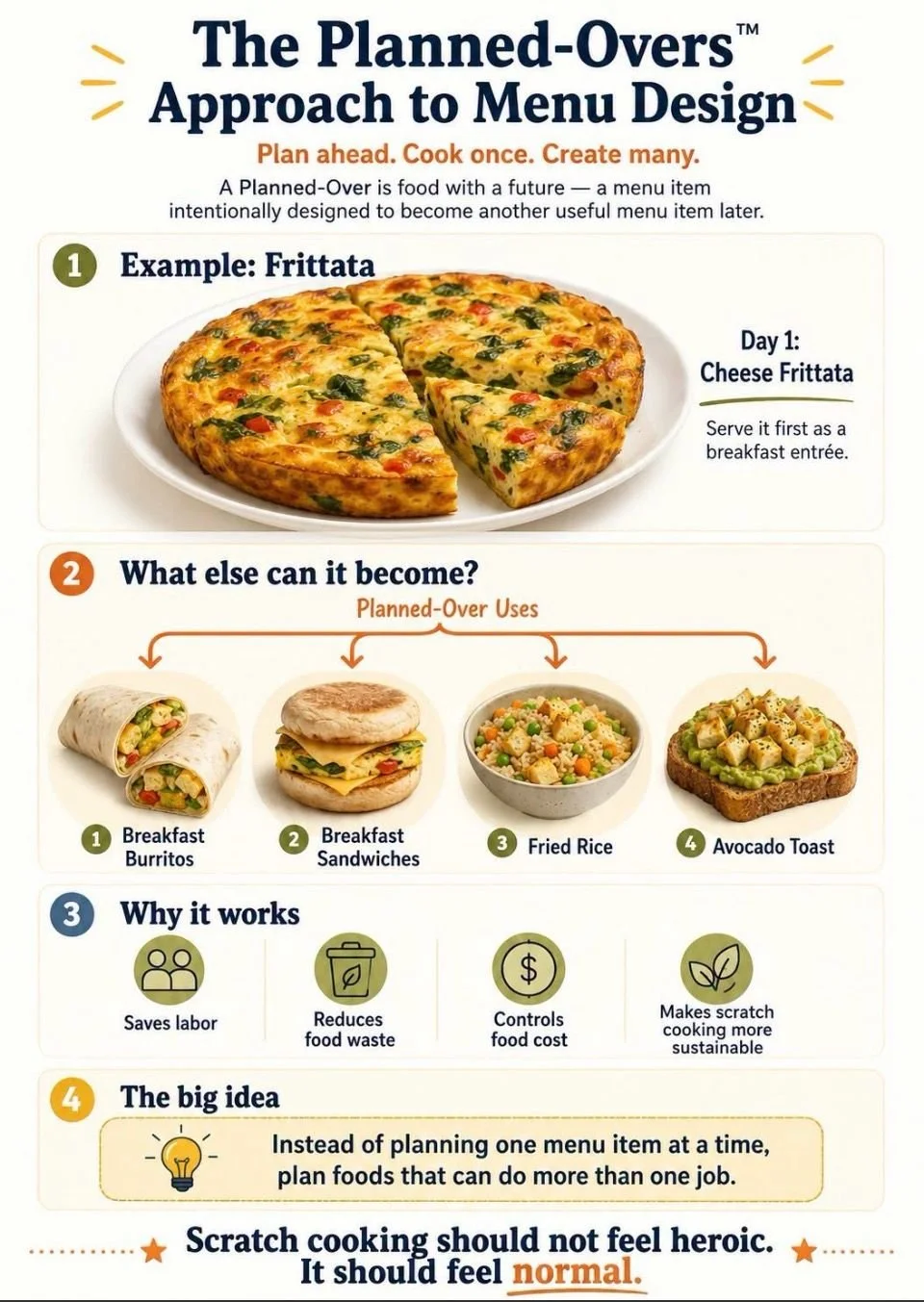
A cheese frittata can be served as a breakfast entrée on Monday. With the Planned-Overs approach in mind, we not only make what we need for breakfast today, we also make a little extra that we cool and save for Wednesday's menu. Instead of making a separate egg filling on Wednesday for breakfast burritos, we maximize our labor by making it once on Monday while we have all the ingredients out. Any frittata that is left from Monday's service can then be diced and used in breakfast burritos, breakfast sandwiches, fried rice, or even as a topping for avocado toast.
Scratch granola can be served with yogurt parfaits, added to smoothie bowls, used as a muffin topping, or rolled into no-bake protein bites.
Roasted potatoes can be served as a breakfast side, then used again later in burritos, hash, or oven-fried rice.
Planned-Overs is not about serving old food.
It is about planning ahead so good food has more than one purpose.
When we think this way, the menu becomes more connected. One recipe supports another. One production step saves time later in the week. One ingredient helps create more variety for students.
The Planned-Overs Approach helps school kitchens:
Reduce food waste
Save labor
Stretch food dollars
Increase scratch cooking
Create more menu variety
Make better use of food already prepared
In a strong school nutrition program, the food should guide the decisions we make. The menu affects what we buy, how we store, how we prep, how we cook, how we staff, what equipment we need, and what students experience on the serving line.
Every food has a path through the kitchen. It starts with the menu, then moves through purchasing, receiving, storage, preparation, cooking, and service, and finally lands on the student's tray. What happens after that matters too. Was it eaten? Shared? Saved? Thrown away?
The more we understand that path, the better we can manage it.
Planned-Overs helps us ask better questions:
What else can this become?
Can today's side dish become tomorrow's breakfast item?
Can this bread become croutons or strata?
Can this fruit become a smoothie base or sauce?
Can this rice become fried rice or burrito filling?
These small questions can lead to big improvements. And big savings.
The goal is not to make more food than we need. The goal is to design menus with intention, so when extra food happens (and it will), we already have a smart plan for it and we can maximize our labor.
In school food service, scratch cooking is not just about recipes. It is about skills and systems. And one of the best systems we can build is a menu where every ingredient has a future.
Ready to make Planned-Overs part of your school kitchen?
If the Planned-Overs Approach sounds like the kind of thinking your team needs, that is exactly what Chef Kent Getzin Consulting brings to school kitchens. Through on-site training, operational reviews, and long-term scratch-cooking programs, Kent works shoulder-to-shoulder with school food service teams to build the skills and systems that make this kind of intentional cooking possible every day. Ready to start the conversation?